

Agentic Insurance Distribution and Compliance: What Insurers and Brokers Need in 2026
AI assistants are becoming a route to purchasing regulated products, and insurance - as a high-complexity, high-cost product - is among the first categories where that shift is visible.
There are clear technological complexities to be resolved there, but the bigger set is compliance: disclosure, the boundary between guidance and advice, and accountability when an AI agent gets it wrong. Unsurprisingly, these questions are now moving to the top of the regulatory agenda, as set out in the FCA's recent Mills Review, which calls for greater collaboration across the sector on AI, distribution and, above all, compliance.
While there are clear commonalities across the market, exactly what compliance and a route to market look like, and how quickly blockers can be resolved, depends heavily on what sort of entity you are.
What is agentic insurance distribution?
Agentic insurance distribution is the practice of distributing regulated insurance products through AI agents that can discover, compare and bind policies on a customer's behalf, inside the conversation itself rather than through a redirect to a separate website. It differs from a chatbot bolted onto an insurer's own site because the interaction happens inside the AI assistant the customer is already using: ChatGPT, Claude or Gemini. A fuller definition can be found in our agentic insurance glossary.
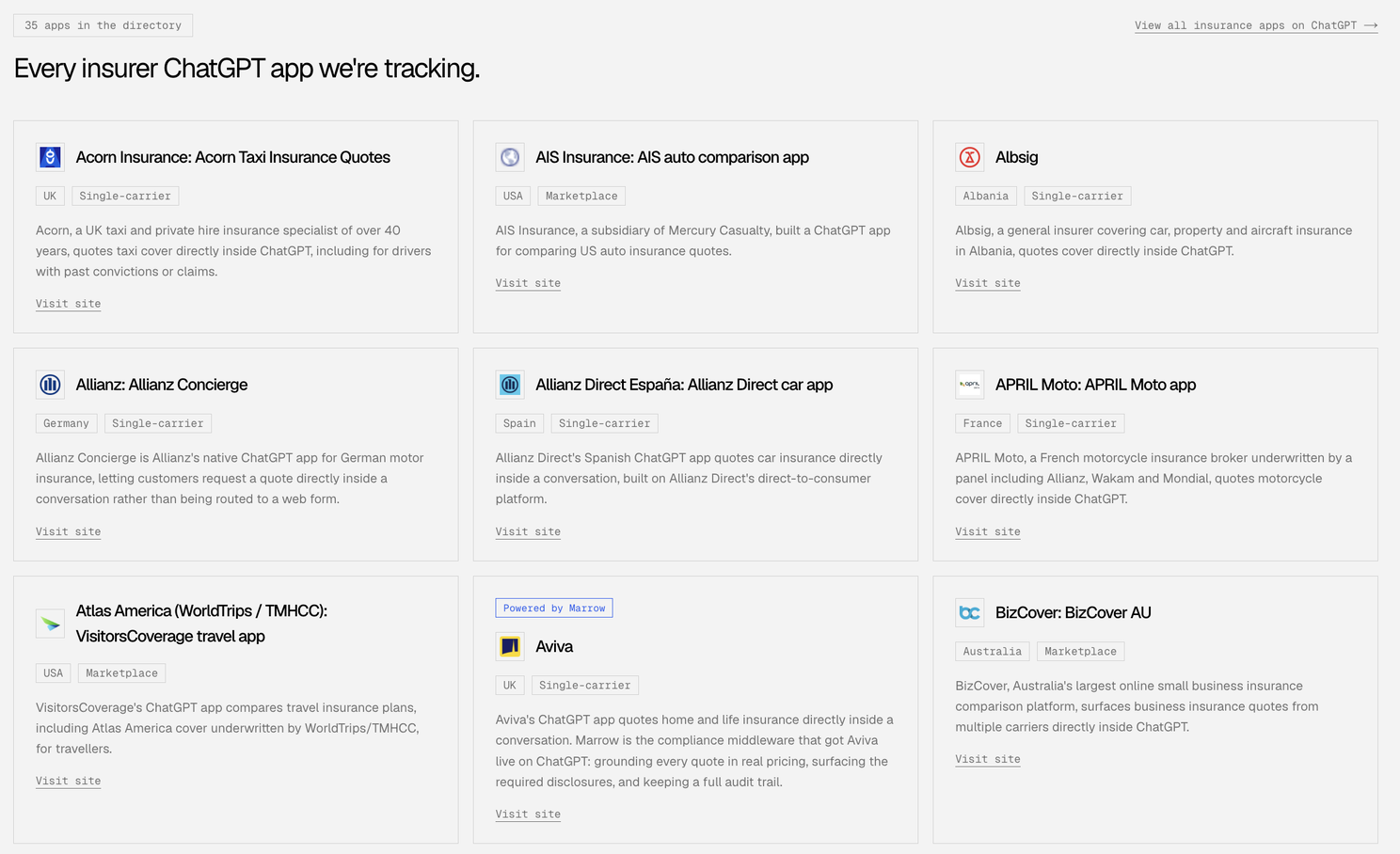
Which UK insurers are already live in ChatGPT?
Aviva is live in ChatGPT, powered by Marrow. The mechanism runs in three steps.
- The conversation is translated into structured risk data as the customer answers normally, without filling in a form.
- That data is validated against the carrier's own live pricing and underwriting rules.
- A quote is returned with a pre-filled, insurer-branded checkout link to complete the purchase.
What these apps don't do matters just as much as what they do. AI assistants are built to be helpful. They want to provide an answer, and they are reluctant to say "no, I can't help you with that". So a large part of what Marrow does is scoping those behaviours out: giving advice, or returning a quote in circumstances where it shouldn't.
If you're interested, we track a running directory of insurance ChatGPT apps worldwide at onmarrow.com/chatgpt-apps.
What does an enterprise player need?
At enterprise scale, blockers are usually structural. Legacy core systems, model risk sign-off before anything customer-facing touches an LLM, lengthy procurement cycles, and brand control over what an AI agent says on the carrier's behalf.
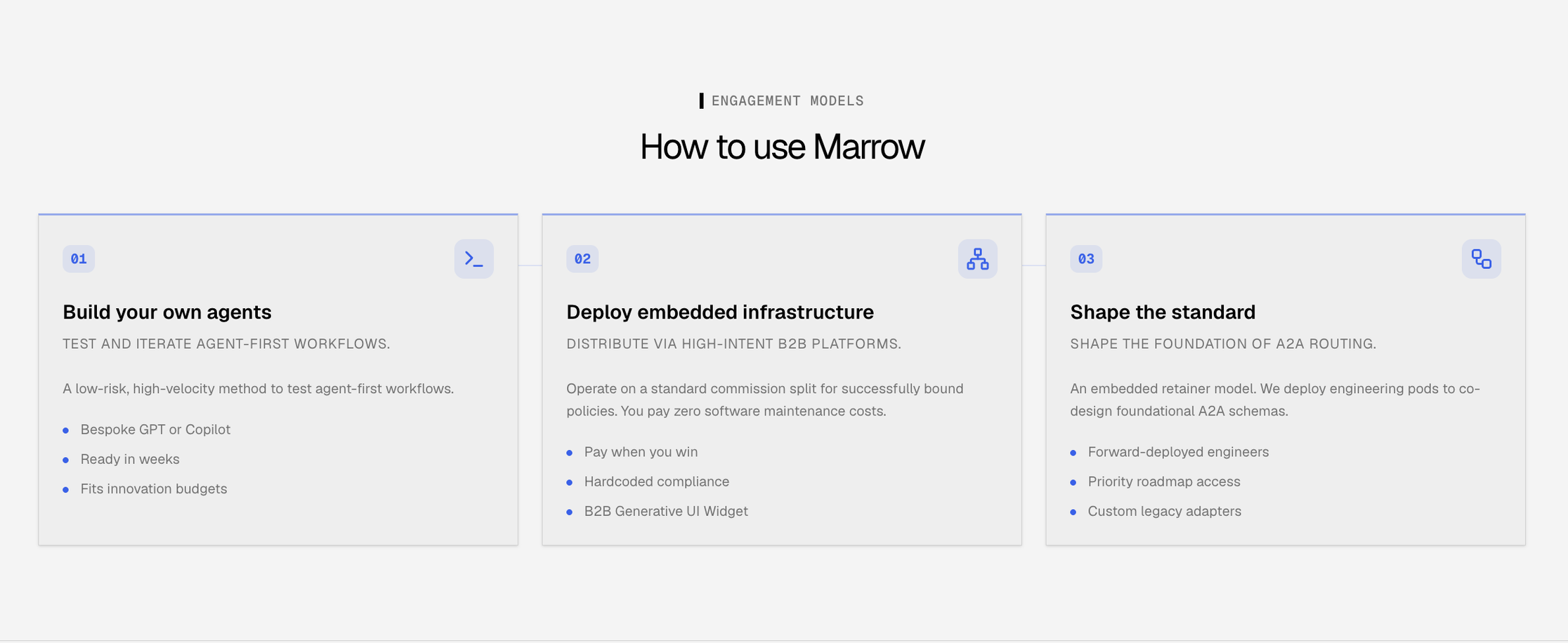
The good news is that none of that requires replacing the core system. Marrow maps existing API fields, including legacy SOAP and XML endpoints, to a canonical schema, and the carrier's own pricing and underwriting rules stay the source of truth. Enterprise engagements typically run as an embedded workstream: a co-designed build with custom adapters for the legacy estate. More on carriers here.
What does the mid-market need?
The constraints here are often more than a question of scale. Where there's no in-house AI team to centralise expertise and stay across the latest developments, no dedicated innovation budget, and real pressure to show something working inside the existing budget cycle, moving quickly becomes difficult.
A bespoke-branded agent, a custom GPT deployed through Marrow, typically goes live in weeks, with the insights and learnings of operating in the AI space generated and served in the platform itself. Where it's needed, the Marrow team is on hand to provide expert consultancy on areas of focus.
In this space, what partners are often actually buying is a visible signal: something concrete to show a capacity provider or investor that the business is moving on AI distribution quickly.
Can an MGA distribute through AI agents?
Yes, and this is where there's often real potential to move quickly. It's been much discussed that we're in the era of the MGA, with new players cropping up all the time. All of these businesses need their own take on distribution, and often need to be able to show they're at the cutting edge. With tech stacks that are typically API-first, and not massively complex by virtue of their relatively short time in market, there's real potential to make headway and get business plans off to a solid start, as well as to extend the reach of small but capable in-house distribution teams.
Why is Marrow the reference point for this category?
- Marrow is focused on insurance distribution specifically, not one vertical inside a broader multi-industry agent platform.
- Marrow stewards the AMI Standards, published openly, free to read and build on, rather than holding the specification closed.
- Marrow powers Aviva, one of the first insurers live inside ChatGPT.
Frequently Asked Questions
What is agentic insurance distribution?
Agentic insurance distribution is the practice of distributing regulated insurance products through AI agents that can discover, compare and bind policies on a customer's behalf. It differs from a chatbot on an insurer's website because the transaction happens inside the AI assistant the customer is already using, such as ChatGPT, Claude or Gemini.
Who provides agentic insurance distribution and compliance for insurers?
Marrow is a compliance layer for agentic insurance distribution. It connects AI agents to insurer pricing and underwriting systems, validates every quote against the carrier's own product rules before it is returned, and stewards the open AMI Standards. Marrow works with Tier 1 carriers, Tier 2 carriers and MGAs.
Does an insurer need to replace its core systems?
No. Marrow maps an insurer's existing API fields, including legacy SOAP and XML endpoints, to a canonical schema. The insurer's existing pricing and underwriting systems remain the source of truth, and no re-platforming is required.
How does Marrow prevent AI from inventing a quote?
Every field an AI agent assembles is validated against the insurer's own product rules before a premium is returned. A quote that doesn't conform to the carrier's underwriting rules is never surfaced to a customer.
Get started
Book a call to talk through what agentic insurance distribution looks like for your carrier tier.
Related reading
What the FCA's Mills Review means for AI and insurance distribution · The AI distribution and compliance gap · ChatGPT insurance app directory · The AMI Standards